Thursday, March 11, 2010

George Grosz

"George Grosz (July 26, 1893 – July 6, 1959) was a German artist known especially for his savagely caricatural drawings of Berlin life in the 1920s. He was a prominent member of the Berlin Dada and New Objectivity group during the Weimar Republic before he emigrated to the United States in 1933."

Similar to Riefenstahl, his artwork was primarily following the events of the first World War. The difference is that while Riefenstahl may have been loyal to the German troops, Grosz despised them. His anti-war movement had him in much trouble throughout his time in Germany, including being arrested in 1919. Soon, he moved to America and became a teacher at the Art Students League of New York.

http://en.wikipedia.org/wiki/George_Grosz


George Grosz. Suicide.Suicide. 1916. Oil on canvas. 100 x 77.6 cm. Tate Gallery, London, UK.

George Grosz. Lovesick.Lovesick. 1916. Oil on canvas. 99.7 x 76.5 cm. Private collection.

George Grosz. Republica Automatons.Republica Automatons. 1920. Watercolor on paper. 60 x 47.3 cm. The Museum of Modern Arts, New York, NY, USA.

George Grosz. Eclipse of Sun.Eclipse of Sun. 1926. Oil on canvas. 210 x 184 cm. Heckscher Museum, Huntington, NY, USA.

George Grosz. Self-Portrait, Warning.Self-Portrait, Warning. 1927. Oil on canvas. 98 x 79 cm. Galerie Nierendorf, Berlin, Germany.

http://www.abcgallery.com/G/grosz/grosz.html


So overall, I'm finding few similarities between this man and Leni Riefenstahl, but they both appear to be genius artists. With such bizarre imagery and caricatures, I find George Grosz a bit more similar with Otto Dix.

Thursday, March 4, 2010

Riefenstahl Biography

For a while, Riefenstahl studied painting and dancing. She continued to dance and made it far in her career until she was injured in the knee. She carried on as an actress and soon a director, writer and producer. Her movie, "Triumph of the Will", was highly praised until the German World War it was based on came to an end and it was seen by many as sheer propaganda. Her two-part "Olympic Games" movie went through a similar process. Later, she went on with a photographing career to take snapshots of her stay with a tribe called the Nuba. These photos were published to books and magazines. At 71, she took a diving course and then became an underwater photographer as well. That's about as far as I feel required to write, but you can't help but admire a woman who can pull off a life as a dancer, actor, writer, director, producer and photographer and do so well at all of them. Next, I compare her with some other German artists...

http://www.leni-riefenstahl.de/eng/bio.html

Wednesday, February 24, 2010

Leni Riefenstahl

Leni Riefenstahl was a German director, actress and dancer. She is most notable for the direction of "Triumph des Willens" or "Triumph of the Will". She also directed movies such as "The Blue Light", "Victory of Faith" and "Lowlands". Her acting career included "The Holy Mountain", "The White Hell of Pitz Palu" and "S.O.S. Eisberg". More on her later...

http://en.wikipedia.org/wiki/Leni_Riefenstahl

Tuesday, February 23, 2010

Otto Dix

"Otto Dix (1891-1969), the great German Expressionist, was famous for his unique and grotesque style. Although Hitler's Nazi regime destroyed many of Otto Dix's works, the majority of his paintings can still be seen in museums throughout Germany."

Self-portrait as Mars, 1915


The Skat PLayers, 1920


To Beauty, 1922


The Seven Cardinal Sins, 1933


Masks as Ruins, 1946


http://www.mess.net/galleria/dix/


Dix was also well-known for his depictions of war in Germany and its effects on the German society. A share of his works was destroyed by the Nazis, but most still survive.

Trench Warfare, 1932


http://www.spartacus.schoolnet.co.uk/ARTdix.htm

Egon Schiele


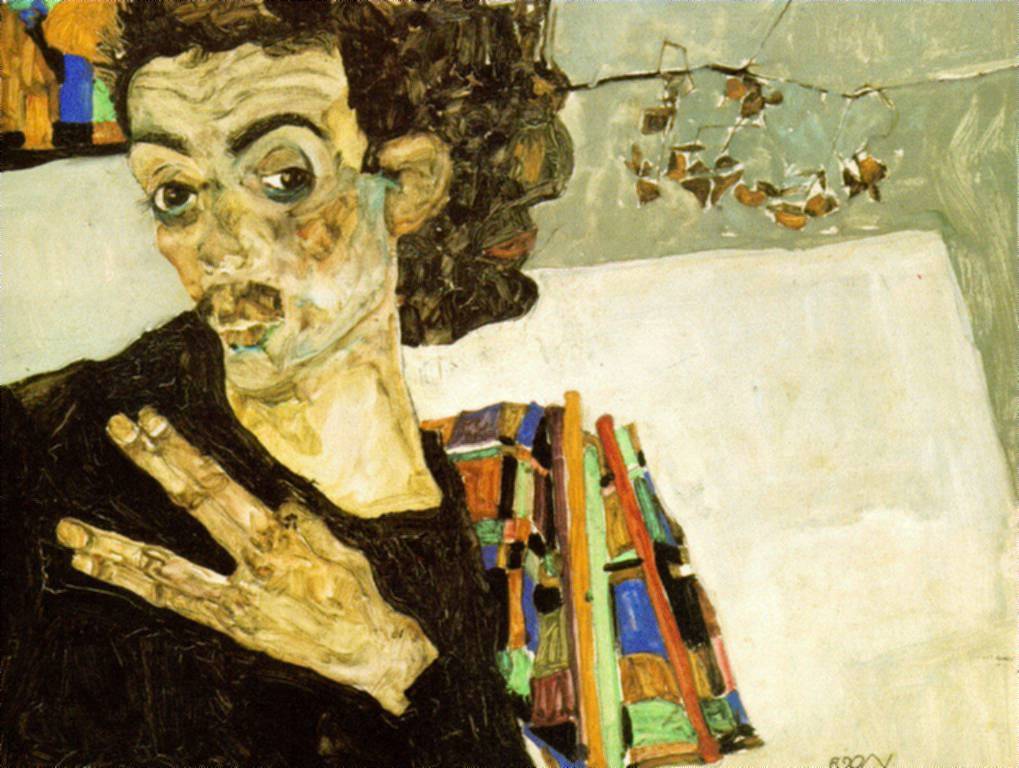
Self Portrait with black Vase
1911, oil on wood, Historiches Museum der Stadt, Wien/Vienna (100 Kb)
(thanks to Harlan Wallach)

Egon Leo Adolf Schiele, 1890-1918, was an Austrian expressionist who was controversial for the erotic depictions in his artwork. In 1907, he met Gustav Klimt, who did similar artwork, and whom Schiele took after for the first few years. But soon, he picked up his own art style that involved jagged lines to express the artwork. Eroticism was a major theme in his pieces, which had him briefly imprisoned for
obscenity in 1912.

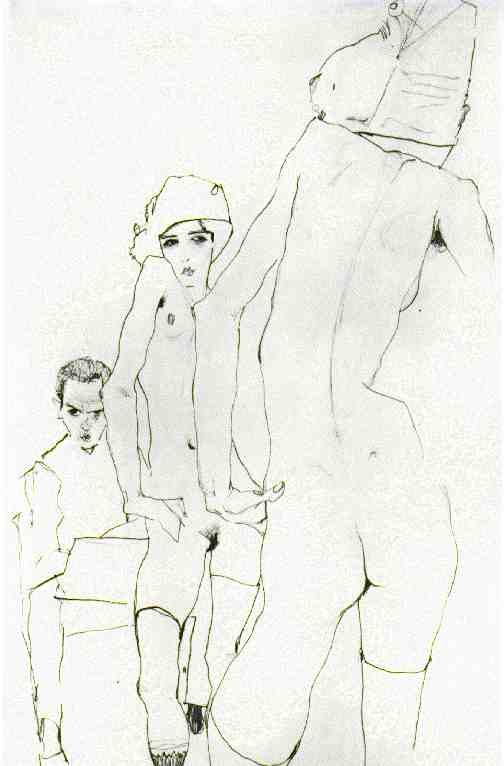
Schiele drawing nude before mirror
1910, pencil, Graphische Sammlung Albertina, Vienna


http://www.ibiblio.org/wm/paint/auth/schiele/


More Wikipedia

The most commonly used expression in expressionism is angst, but other expressions can be used. The art form is originated from Germany in the early 1900s. Artists in the genre include Otto Dix, Ernst Ludwig Kirchner, Paula Modersohn-Becker, Philip Guston and Willem de Kooning. Categories include New York Figurative Expressionism, Lyrical Abstraction, Bay Area Figurative Movement, Abstract Expressionism and Neo-Expressionism.

http://en.wikipedia.org/wiki/Expressionism

Beginning Studies

I guess the best place to start any studies is Wikipedia.

"Its typical trait is to present the world under an utterly subjective perspective, violently distorting it to obtain an emotional effect and vividly transmit personal moods and ideas." So basically it is a work of art that uses its mood to express the situation being depicted.

http://en.wikipedia.org/wiki/Expressionism